A Sweet Partnership As the calendar turned to 2025 and we finished our end-of-year paperwork,…
Maple Becomes Big Business in Franklin County
Sap is flowing, the buckets are hanging from trees and the steam is billowing from country sugarhouses all over the state.
It’s an image that helps sugarmakers market their syrup. But it’s no longer a very accurate picture.
Maple has become big business. In the past ten years, the number of trees that aretapped has tripled and technological advancements have doubled the amount of syrup produced for each tap.
AtJ.R. Sloan’s sugarhouse in Fletcher, the sap arrives in five-axle trucks with tankers on the back.
The trucks back up and pump sap into underground pipes that lead to tanks in the basement.
After being tested, it travels through a series of tubes to the reverse osmosis machines where the sap’s sugar content is concentrated. It eventually makes its way into one of the sugar house’s two enormous 6 foot by 16 foot evaporators, where it becomes maple syrup.
See what they’re pulling off the rig right there, that’s fancy, that’s our best product you can make that’s the highest money, Sloan says.
This is the new image of maple production in Vermont.
This sugarhouse depends on sap from 95,000 taps. Sloan only owns 14,000 of those taps. The rest come from other land owners, who get paid for the saptheir trees produce. Some even hire Sloan’s GreenMountain Mainlines company to tap their trees. It’s been a big decade of growth since Sloan built his first sugarhouse.
That cost $117,000 to build that with all the equipment and we grossed $239,000.Syrup went wicked high that year. I got into it at just the right time, Sloan said.
And it’s been up ever since.
The second year we did 22,000 taps, the third year we boiled 45,000 taps in that little building. Then we made enough money to put toward that new facility. And when we went with the new facility we went with 70,000 taps. The we had the worst year ever last year. This year is going ok, Sloan said.
Green Mountain Mainlines’s goal is 32,000 gallons of syrup.
Sloan has taken advantage of grants to improve efficiency and food safety. But he says while maple syrup brings in good money, the equipment and fuel required is a big investment.
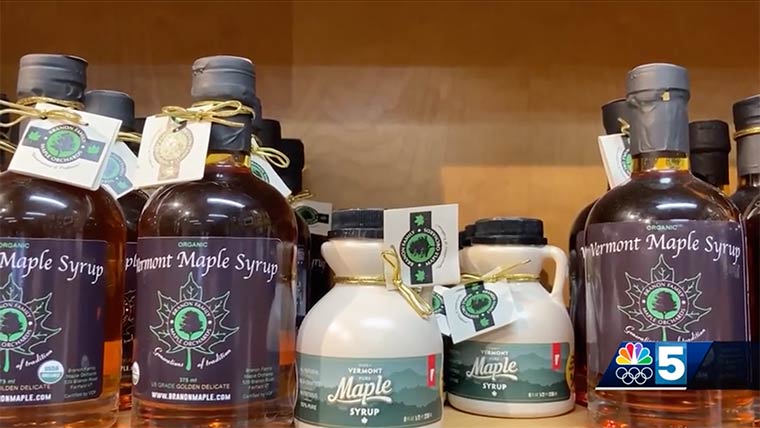
Even family operations have changed. A few miles away in Fairfield, Cecile Branon at Branon Maple Orchards, agrees.
There’s people getting into it thinking this is a get rich type of thing. It’s not. The investments that you have to make are unbelievable. And as the economy changes and so does petroleum the costs of all the supplies go up, Branon said.
Branon uses the evaporator as an example, that’s about $85,000 that’s the evaporator.One RO, 8 membrane RO you’re looking at $60-65,000, Just little fittings in the woods 32 cents a piece and you use thousands of them, she explains.
Branon says while some of those improvements cost money, they do pay off. Reverse osmosis allows sugarmakers to use 14 times less oil to make a gallon of syrup.
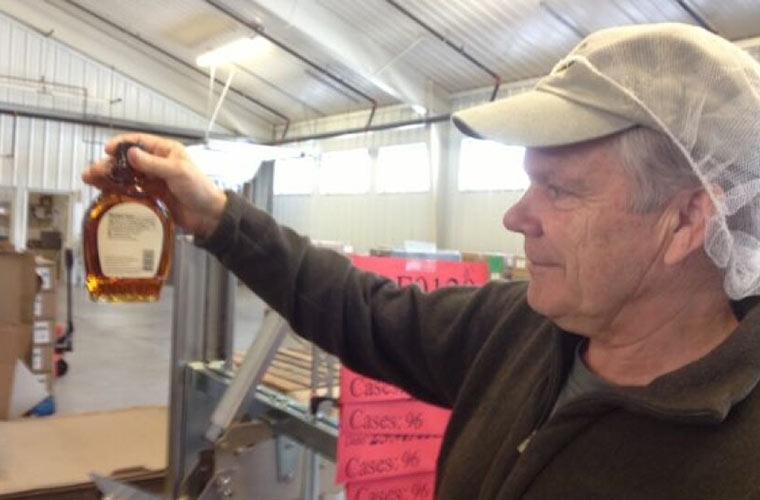
Branon Maple Orchards has 66,000 taps and it’s become a year-round business for her, her husband and two sons.
Sugaring for us is 12 months a year. when you get done you need to clean the lines pull the taps from the trees, take care of your woods. Every year we redo a section of the woods that might be older tubing, there’s always something that you can make work better. And to be at this volume, you can’t do this volume with buckets, Branon says.
That means tubing that sometimes goes back a mile into the woods. And while they do sell some syrup online and at the farm, it’s more than they can handle alone.
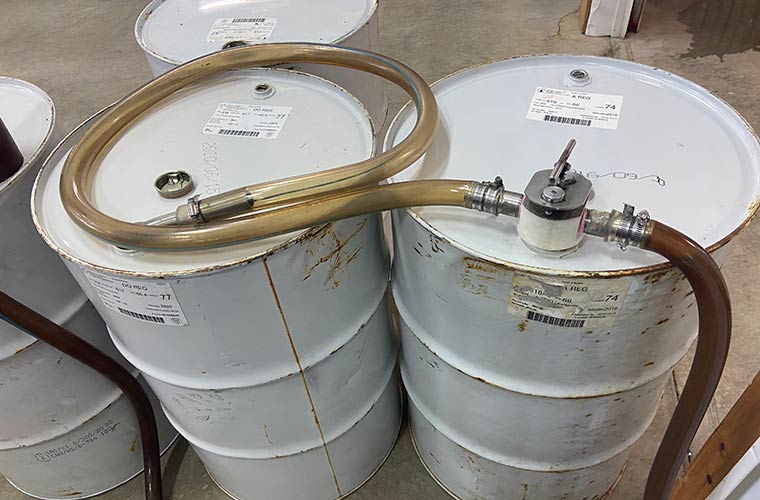
And that gets us back to those 55-gallon drums we mentioned earlier. The syrup is packed in these barrels and it’s sent to Butternut Mountain Farm. That’s where David Marvin shows off the production line.
This is the heart of our operation, there is where we batch syrup to color and flavor specs for each packing line, syrup is pumped in, warmed up enough to gothrough filter pressed, then the drums are steam cleaned and returned to farm.Our new system will have piping from warehouse direct into heating tanks, he explains.
Butternut Mountain Farm has a store in Johnson and a sugarbush with 14,000 taps. But the heart of the operation is a warehouse in Morrisville where owner David Marvin estimates they handle more than 50 percent of Vermont’s maple crop every year.
We are, I suppose, the classic middle man in that we provide the aggregation that’s necessary to supply some very big customers. Our best and biggest customers are far bigger than any individual producer could ever supply. So without us all working together we could never reach that market. Marvin says.
The syrup is packaged and labeled to be sold at major retail and grocery chains and natural foods markets. Some commercial syrup is shipped to bread makers and cereal companies in 250 gallon totes. Some is made into maple sugar.
Marvin says he’s been able to keep up with the increased production.
There’s a push on the side of producers/sellers that have been loyal to me all these years, and there’s a pull on our customers side, and that’s caused us this growth over 40 years, Marvin says.
Now 70 people work year round at the facility.
Marvin says the changes have been good for the industry.
It is a different industry. And I think the consumer is better served by who we are today.
And he’s happy to see so many producers making maple into a year-round business just like he dreamed of doing, 40 years ago.
Originally published on Vermont Public Radio.
Related Posts